
pop culture locations from movies, music, tv & more...
rick rubin’s dorm room
from rick rubin, def jam records, ll cool j, beastie boys posted in music by pete_nice
In 1981, a long-haired philosophy major named Frederick Jay Rubin enrolled at NYU. Rick had started making recordings under the moniker Def Jam Records while in high school at Lido Beach, NY. He continued to produce recordings while in his dorm room (#802) on the eighth floor of Weinstein Hall.
In 1983, Rubin had befriended Zulu Nation's Jazzy Jay, who taught Rubin about hip hop production. Later that year, the Beastie Boys had an unexpected hit with their pseudo-hip hop song "Cooky Puss" off their Pollywog Stew EP. They hired Rubin to DJ for them as they made the transition from a hardcore punk band to a hip hop act.
Def Jam Records put out their first hip hop track, "It's Yours" by T La Rock, in 1983. The single was produced by Rubin and Jazzy Jay and distributed by Streetwise Records. Rubin was introduced to promoter/manager Russell Simmons by Jazzy Jay, and Jazzy was edged out of Def Jam shortly after.
In 1984, Def Jam put out the debut single by Queens rapper LL Cool J called "I Need a Beat." The song was written by James Todd Smith (LL Cool J), Adam Horovitz (King Ad-Rock), and Rick Rubin.
Along with the Beastie Boys Rock Hard EP, "I Need a Beat" features the earliest logo artwork and catalog numbers for Def Jam Recordings. Rock Hard is the first rap attempt by the Beastie Boys, but is not available in the US because it features an unlicensed sample from AC/DC. The song is essentially a prototype of the hard-rock/hip hop fusion that would make Licensed to Ill enormously successful.
 view full location details...
edgar allan poe birthplace
from edgar allan poe posted in literature by tacopolis
Born on January 19, 1809, Edgar Allan Poe was the son of David and Elizabeth (Eliza) Poe, actors at the Boston Theatre. Poe's father left early on, and his mother died before he reached the age of three. Edgar was raised as a foster child by the Allan family of Richmond, VA from that point on.
At the time of his birth, this building's address was #62 Carver St. However, there have been a number of street moves and renames since 1809.
In 1924, the Boston Authors' Club put a memorial tablet to Edgar Allan Poe on a building at the corner of Fayette St. and Poe Sq. However, this was an incorrect placement. According to later property records research by the Bostonian Society, the Poes lived at 62 Carver St. when Edgar Allan was born.
The building survives today, and is near the intersection of Charles St. South and Stuart St.
 view full location details...
the broadway journal
from edgar allan poe posted in literature by tacopolis
Founded by Charles Frederick Briggs and John Bisco in 1844, The Broadway Journal was a short-lived magazine that specialized in literature and literary review, criticism of art, theater, and music as well as poetry and articles on politics.
Riding the wave of success that "The Raven" generated, Edgar Allan Poe signed a year-long contract as editor on February 21, 1845. Poe wrote a number of short stories for the Journal, including including "The Masque of the Red Death" and "The Oval Portrait." He also wrote a number of literary criticism pieces, and continued to publicly accuse Henry Wadsworth Longfellow of plagiarism.
Despite his efforts, The Broadway Journal officially ended with a final issue dated January 3, 1846.
 view full location details...
the new york evening mirror (former)
from edgar allan poe posted in literature by tacopolis
This address was the former location of The Evening Mirror and The Weekly Mirror- George Pope Morris and Nathaniel Parker Willis, editors & publishers.
Edgar Allan Poe worked here from October, 1844, to February, 1845. Willis was a well-paid ($1,500 a year) and popular writer, but he recognized talent in Poe.
On January 29, 1845, Willis published "The Raven" in the Evening Mirror. Poe had recently left the Mirror to join Charles Briggs as co-editor at The Broadway Journal. The poem became an immediate success, and Poe's fee had dramatically increased to $50 a poem.
Of the poem's success, Poe wrote a friend:
‘The Raven’ has had a great ‘run,’ Thomas—but I wrote it for the express purpose of running—just as I did the ‘Gold-Bug,’ you know. The bird beat the bug, though, all hollow.
 view full location details...
the sun newspaper (former)
from edgar allan poe posted in literature by tacopolis
The Sun was a New York broadsheet newspaper that was published from 1833 until 1950.
Later in its life, The Sun became a reputable paper. It was considered the most conservative voice of the big three NYC papers- The New York Times and the New York Herald Tribune being the others.
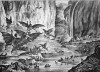
In its earlier years, while it was headquartered at this address, The Sun would occasionally fabricate hoaxes to draw readership. One such successful hoax was the Great Moon Hoax of August, 1835, which was a series of six articles that told fantastic stories of forests and oceans on the moon, inhabited by bison, goats, unicorns, bipedal tail-less beavers and bat-like winged humanoids ("Vespertilio-homo").
Edgar Allan Poe had written a story two months prior (in June of 1835) called The Unparalleled Adventure Of One Hans Pfaall for the Southern Literary Messenger, where an adventurer takes a balloon to the moon and encounters many similarities. Poe complained that the Great Moon Hoax was at least partially plagiarized from his story (which is considered one of the earliest examples of science-ficton).
Poe would have his own successful hoax for The Sun in 1844: "The Balloon-Hoax." Poe's fictional (yet factual-sounding) article disclosed that famous European balloonist Monck Mason had crossed the Atlantic Ocean in 75 hours. The details of the article included a diagram and specifications of the craft. The newspaper was swarmed with people to get copies of the paper, and even though the story was retracted two days later, readership had massively increased.
 view full location details...