
edgar allan poe
posted in literature
the broadway journal
from edgar allan poe posted in literature by tacopolis
Founded by Charles Frederick Briggs and John Bisco in 1844, The Broadway Journal was a short-lived magazine that specialized in literature and literary review, criticism of art, theater, and music as well as poetry and articles on politics.
Riding the wave of success that "The Raven" generated, Edgar Allan Poe signed a year-long contract as editor on February 21, 1845. Poe wrote a number of short stories for the Journal, including including "The Masque of the Red Death" and "The Oval Portrait." He also wrote a number of literary criticism pieces, and continued to publicly accuse Henry Wadsworth Longfellow of plagiarism.
Despite his efforts, The Broadway Journal officially ended with a final issue dated January 3, 1846.
 view full location details...
the new york evening mirror (former)
from edgar allan poe posted in literature by tacopolis
This address was the former location of The Evening Mirror and The Weekly Mirror- George Pope Morris and Nathaniel Parker Willis, editors & publishers.
Edgar Allan Poe worked here from October, 1844, to February, 1845. Willis was a well-paid ($1,500 a year) and popular writer, but he recognized talent in Poe.
On January 29, 1845, Willis published "The Raven" in the Evening Mirror. Poe had recently left the Mirror to join Charles Briggs as co-editor at The Broadway Journal. The poem became an immediate success, and Poe's fee had dramatically increased to $50 a poem.
Of the poem's success, Poe wrote a friend:
‘The Raven’ has had a great ‘run,’ Thomas—but I wrote it for the express purpose of running—just as I did the ‘Gold-Bug,’ you know. The bird beat the bug, though, all hollow.
 view full location details...
the sun newspaper (former)
from edgar allan poe posted in literature by tacopolis
The Sun was a New York broadsheet newspaper that was published from 1833 until 1950.
Later in its life, The Sun became a reputable paper. It was considered the most conservative voice of the big three NYC papers- The New York Times and the New York Herald Tribune being the others.
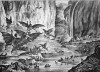
In its earlier years, while it was headquartered at this address, The Sun would occasionally fabricate hoaxes to draw readership. One such successful hoax was the Great Moon Hoax of August, 1835, which was a series of six articles that told fantastic stories of forests and oceans on the moon, inhabited by bison, goats, unicorns, bipedal tail-less beavers and bat-like winged humanoids ("Vespertilio-homo").
Edgar Allan Poe had written a story two months prior (in June of 1835) called The Unparalleled Adventure Of One Hans Pfaall for the Southern Literary Messenger, where an adventurer takes a balloon to the moon and encounters many similarities. Poe complained that the Great Moon Hoax was at least partially plagiarized from his story (which is considered one of the earliest examples of science-ficton).
Poe would have his own successful hoax for The Sun in 1844: "The Balloon-Hoax." Poe's fictional (yet factual-sounding) article disclosed that famous European balloonist Monck Mason had crossed the Atlantic Ocean in 75 hours. The details of the article included a diagram and specifications of the craft. The newspaper was swarmed with people to get copies of the paper, and even though the story was retracted two days later, readership had massively increased.
 view full location details...
e.a. poe’s former nyc boarding house
from edgar allan poe posted in literature by tacopolis
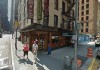
On April 6, 1844, Edgar Allan Poe arrived in New York City with his wife, Virginia, who was suffering from tuberculosis. Poe had left a successful post as the editor of the magazine Graham’s Magazine in Philadelphia, and was in New York City without a residence or income. His goal was to escape periodicals of "a nambypamby character" and establish his own magazine.
The family settled in a boarding house at the corner of Cedar and Greenwich Streets. Of the location, Poe said:
"The house is old and looks buggy. . . The landlady a nice, chatty old soul—gave us the back room on the third floor—night & day attendance—for 7$—the cheapest board I ever knew, taking into the consideration the central situation and the living...
Today, the corner is home to O'Hara's Restaurant and Pub.
 view full location details...
edgar allan poe cottage
from edgar allan poe posted in literature by tacopolis
The Poe family- Edgar Allan, wife Virginia, and mother-in-law Maria Clemm- moved into this simple, unassuming cabin in May of 1846. At that time, Fordham was a rural community and the cabin was situated on two acres of vacant land.
Judging by the correspondence that Poe sent, the family thoroughly enjoyed the small cabin. Poe became drinking and gambling buddies with the faculty of nearby St. John's College (now Fordham University). Poe wrote his poems "Annabel Lee" and "Ulalume" here, and the story "Landor's Cottage" was undoubtedly shaped by his time there.
Virginia Poe suffered from tuberculosis, and died in the cottage on January 30, 1847. Maria Clemm moved out of the cabin after Edgar died in Baltimore in 1849.
The cottage was sold at auction in 1889 for $775 to William Fearing Gill, who became Poe's first American biographer.
The cabin changed hands several times until the Poe Cottage was moved to Poe Park the corner of Kingsbridge Road and the Grand Concourse. The cottage was placed on the NRHP on August 19, 1980. Tours are available for the cottage.
 view full location details...